
Bring large language models into your own data center
Data stays in your domain, intelligence stays at full strength
From on-prem open-source deployment to industry model fine-tuning, we help you run a fully private LLM on your own servers that truly understands your business. Zero leakage of sensitive data, and compared with calling commercial APIs directly, inference costs can typically be reduced by roughly 40–60%—making AI both secure and cost-effective.
Starter · On-Prem Open-Source Deployment
Run a fully private large language model on your own servers, with data that never leaves your domain.
- Selection and on-prem deployment of mainstream open-source LLMs (Llama / Qwen / DeepSeek, etc.)
- Single-machine or single-GPU deployment with packaged inference service
- Private chat interface + basic RAG knowledge base (connected to your internal documents)
- OpenAI-compatible API for a smooth migration of your existing systems
- Data stays on your servers end to end, with zero leakage of sensitive information
- Deployment documentation + one team training session
From $3,000. Pricing depends on model size / hardware environment / knowledge base data volume—most on-prem deployments land in $3,000–$8,000 (final price subject to requirements assessment).
Advanced · Industry Model Fine-Tuning
Fine-tune a dedicated model on your own business data so it truly understands your industry and workflows.
On top of private deployment, we perform instruction fine-tuning and alignment on your industry corpus, layered with a high-availability inference cluster, an API gateway, and a complete access-audit, monitoring, and alerting system. The Advanced "from $12,000" is a bundled price covering several core modules together; you can also add only the modules you need individually (see the per-module pricing below).
- Includes everything in the Starter tier
- Make the model answer in your industry's terminology and follow your standards (industry fine-tuning / LoRA / domain alignment)
- Turn internal documents into traceable smart Q&A (enterprise-grade RAG knowledge base: multi-source ingestion, vector retrieval, citation tracing, scheduled incremental updates)
- Serve more users on fewer GPUs and amortize long-term cost (multi-GPU optimization / quantization)—compared with calling commercial APIs directly, inference costs can typically be reduced by roughly 40–60%
- Unified API gateway: rate limiting, billing, multi-model routing, and canary releases
- Fine-grained access control and auditing: access governed by department / role, with full conversation logs that remain traceable
- Real-time monitoring and alerting: throughput, latency, GPU memory, and anomalous requests on a single screen
- Post-launch tuning iterations and operations support
From $12,000. Pricing depends on fine-tuning data volume / model parameter size / operations scope—most fine-tuning projects land in $12,000–$40,000 (final price subject to requirements assessment).
A complete private LLM capability stack
From fine-tuning and knowledge bases to deployment optimization, gateway, access control, monitoring, and e-commerce store automation, these modules combine into an enterprise-grade private LLM platform that is ready to launch, operate, and keep compliant.
Make the model answer in your industry's terms (industry fine-tuning / LoRA)
Fine-tune on your own tickets, contracts, and reports so the model speaks your terminology and follows your rules.
from $4,000
Let staff get answers with sources (vector retrieval / RAG knowledge base)
Turn scattered internal docs into traceable Q&A, with every answer citing where it came from.
from $2,000
Serve more users on fewer GPUs (KV caching / multi-GPU parallelism)
Get more throughput from the hardware you already have, so cost per request stays low.
from $1,500
Connect existing systems with zero rework (OpenAI-compatible / API gateway)
One gateway for every model call—rate limiting, billing, routing, and canary releases included.
from $1,200
Control who can ask what (access control / audit logging)
Govern access by department and role, with every conversation and file lookup logged.
from $1,000
Catch faults early (real-time monitoring / alerting)
Watch throughput, latency, GPU memory, and anomalies live, with alerts before users notice.
from $800
Turn product launches into a one-click pipeline (e-commerce store automation)
From your own product data, auto-generate listing copy, images, titles, and SEO—on-prem.
from $2,500
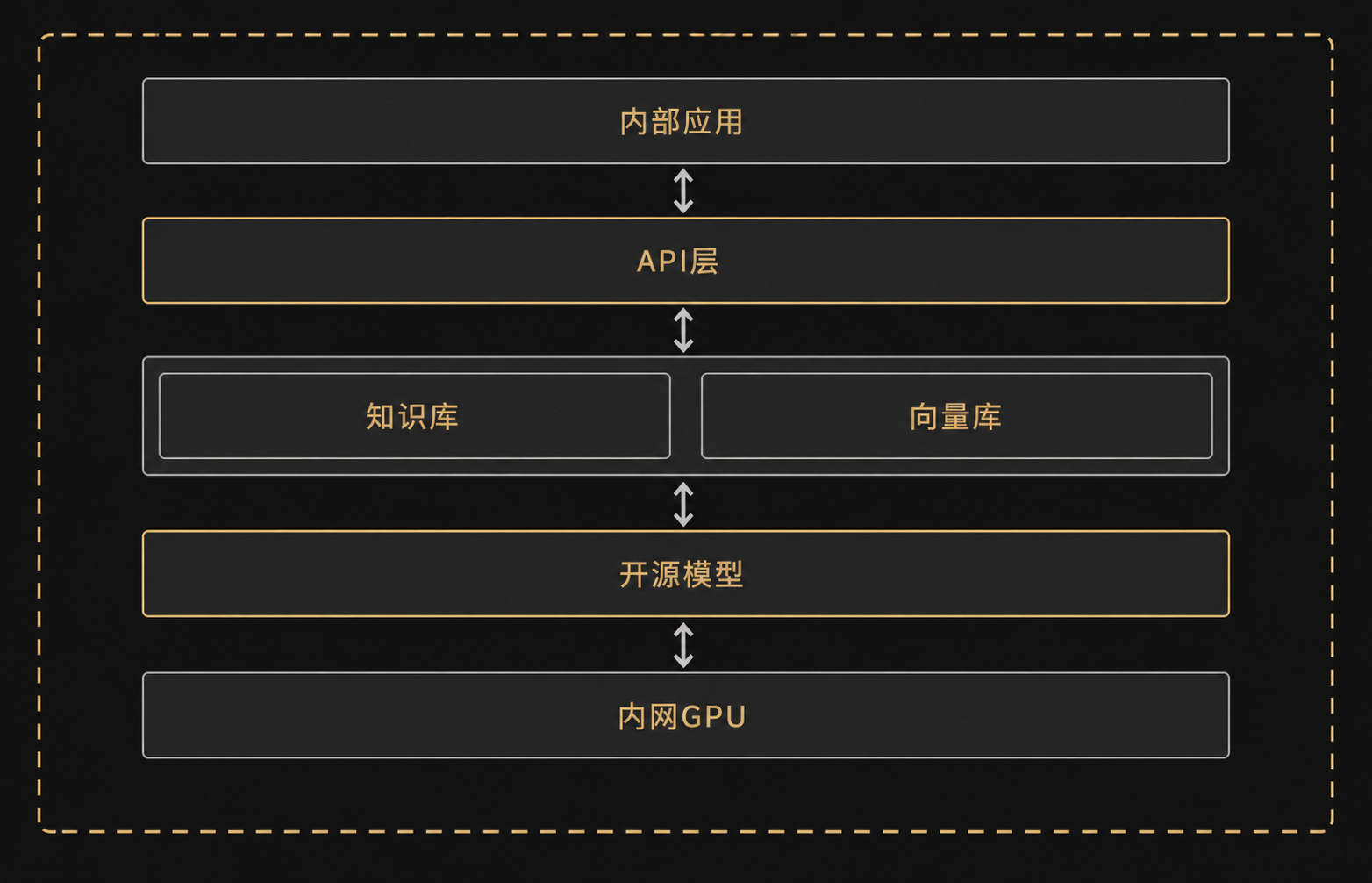
A private architecture that keeps data in your domain
All models, knowledge bases, and inference services are deployed inside your internal network, where external networks cannot reach the data layer directly. Requests are uniformly authenticated and rate-limited through the API gateway, audited end to end, and sensitive information remains on your servers throughout.
From diagnosis to stable operations, four steps to launch
A private LLM isn't install-and-leave—we use verifiable small steps to fit it to your hardware, data, and compliance requirements.
Diagnose
Weeks 1–2Inventory use cases, data assets, and hardware/compliance constraints, decide on model selection and deployment shape, and produce a feasibility and ROI assessment.
Pilot
Weeks 3–6Complete on-prem deployment and basic RAG, fine-tune 1–2 high-value scenarios on your industry corpus, and validate accuracy and response experience with real Q&A.
Launch
Weeks 7–12Stand up a multi-GPU inference cluster and API gateway, wire in access auditing and monitoring/alerting, and migrate existing systems to production smoothly via the OpenAI-compatible interface.
Iterate
OngoingKeep fine-tuning and expanding the knowledge base from real call feedback, optimize throughput and cost, and keep it running stably 24/7.
An internal knowledge assistant for a regional manufacturer
A manufacturing client had process and QC documents scattered across systems, with veteran know-how hard to capture and new hires often searching several systems for answers. We deployed an open-source model inside their network, connected an enterprise-grade RAG knowledge base, and fine-tuned on their process documents—sensitive data never left the internal network. After launch, the team reported a noticeable improvement in how quickly they could find information, and new hires got up to speed faster.
- Industry: discrete manufacturing (anonymized)
- Deployment: on-prem open-source model + enterprise RAG + industry fine-tuning, data never leaves the domain
- Improvement: noticeably faster internal document lookup (in our projects, search time can commonly be cut substantially)
- Cost: compared with calling commercial APIs directly, inference costs can typically be reduced by roughly 40–60%
Ready to get started?
Fill out a short questionnaire and we'll reach out shortly. Final pricing is adjusted based on your specific needs.